6.19.2006

BB post. As William B. Efficacy of the senses/duck or rabbit


Initially the viewer, presuming she has 20-20 vision, will see either a duck or a rabbit. In either case she will be correct, since the drawing is done intentionally to represent both. Her eyes have done their job, by perceiving the physical attributes of the image accurately. If I see a duck, my brain immediately registers the image as a duck, and I will, out of habit, stop looking for any further revelation. Now, if I see a firetruck instead, or a cathode ray-tube, I can see how my sense of vision might be deemed deficient. If I don't know the presenter's reason for showing me the drawing, it's probably simply a matter of luck as to which image will register first: the duck or the rabbit.

In any random group of viewers, assuming they all have 20-20 vision, some will see a rabbit, some a duck. If the viewer knows what is afoot, then she applies her brain and her eyes accordingly, and will eventually, in most cases, make out both images. Bottom line, and this is the part which is hardest for me to put across since I am no good with technical language or terminology, is that, assuming the viewer has 20-20 vision, she will see the actual, concrete information on the page (or screen) correctly. The rest is a matter of how her brain interprets the information-- a matter of intelligence, imagination, disposition, experience, predilections, what have you.

To an illiterate person, written language is merely a random smattering of lines and curves and loops. In this case, it's not his sense of vision which is deficient. He's seeing the same thing the literate person sees. He merely lacks the acquired ability to interpret those lines and curves and loops into sounds and thereby into words and language. And it goes for any of us who are ignorant of a foreign language. If someone speaks Burmese to me, all I will hear are random utterances. As far as concerns strictly the sense of hearing, I am hearing the same sounds as the person who understands Burmese and is able to interpret those sounds properly.

If we pick a thousand people at random and point out a kitchen table to them, anyone with normal eyesight will identify the object as a table. I daresay you would have great difficulty finding someone with normal vision who will identify the object as a tree or a ladder. By and large, our perceptions of the external world are remarkably consistent. Simple communication would be next to impossible if this were not the case. Granted, many people have poor eyesight, poor hearing, in various degrees. Without my glasses I would not be able to drive, for example; but, thanks to man's determination and ingenuity, I am able to put on my glasses and see normally.

Anyone would agree that the senses are fallible, deficient, to various degrees, and even if a person has 20-20 vision, I will grant that he can and often will see objects incompletely, incorrectly; but I don't see how that needs to cast us into any genuine philosophical doubts about the reality of the external world, or the actuality of the objects we perceive, however inaccurately. The human race has been around for a long time: a short time in relation to the cosmos perhaps, but a long enough time, certainly, for us to collectively recognize that our perceptions and interpretations of the world around us are, as I said, remarkably consistent. Civilization, language, communication, art, science, philosophy, are entirely dependent upon, not to mention the result of, such consistency.

Unposted response. Egoism/altruism


My response to B**, who argued that it was moral to expect and receive payment in return for saving a drowning victim's life, and that anything less would constitute a concession to altruism:

As far as the drowner scenario goes for me personally, insisting on receiving payment for saving his life would eliminate the ego-gratifying benefits that saving his life for free conferred upon me, unless I was in a profession in which life-saving was literally a part of my job. In the first place, it would be an admission that a human life was not a thing of value worthy of being preserved for its own sake. I would be embarrassed and ashamed as a human being to ever make such an admission, and it would also be self-damning, since I would be admitting that my own life was not of sufficient value to merit being preserved for its own sake, which would be crushing to my ego and sense of self-worth. In the second place, by reducing the heroic act of saving a life to a mere transaction of goods and services, I am denying myself the honor that would be associated with saving a human life out of little more than an extremely high regard for the value of that life. In one fell swoop I would confess to having no regard for a human life beyond some arbitrary monetary value and simultaneously strip myself of any and all chance to feel that I had acted heroically and valorously.

In other words, the act of saving a human life should confer a great many personal benefits to the person doing the saving, not to gloss over, of course, the enormous benefit received by the person being saved. I agree with you insofar as I think it's plain wrong to stick to the old idea that the greatest act of goodwill or charity is one which entails the least amount of benefit to the doer. Even if such an ideal were possible, which I suppose it may be given an infinity of hypothetical scenarios, why should we strive for it? If in such a scenario the receiver of the act of goodwill or charity were no better off, what possible good can come of the doer depriving himself of all benefits? Seems to me if we can have two that benefit from one act at no greater cost to either party then that should be the most desireable outcome.

Lastly, if you honestly wouldn't save a life (assuming for the sake of argument that the drowner is neither a loved one nor someone you know of in any way that might prejudice your action) unless you were paid in some way, I'd venture to say there could be something missing in you. I would never suggest that you should feel morally compelled to risk your life to save a total stranger; but if the act of rescuing someone, assuming of course that you were able to do so without putting yourself at too great a risk, failed to give you any reward whatsoever simply for the sake of having acted heroically and preserving a thing of value due to your ability to act with courage, skill, and physical prowess, then I guess I never understood a thing about egoism.

6.18.2006

BB post. As "WilliamB". Epistemology/senses/presup


M*** wrote: Not so, I do not believe the pages themselves to hold power or proof reality. Once again a false assertion based primarily on your empericistic view.


If the Bible is your "axiom", as you state below, then presumably one must be able to read the Bible, hear it spoken aloud, or have its contents conveyed to them through signs given via the sense of touch, as in the way Helen Keller was taught. You are putting the cart before the horse. If you want to convince me that the Bible is the perfect word of God, as you say, I have to read (or have its contents conveyed to me through some other sense) the Bible in order to see if your claim is true, and in order to do that I need at least one working sense. If I cannot trust my senses, which is the main thrust of your argument, then how can I trust what I read with my eyes? Think of what you are proposing: you claim that the senses are untrustworthy, and simultaneously claim that the only thing we can trust is the word of God as put down in the Bible, which cannot be received and understood without the senses.

As someone else said, the presuppositionalist arguments are sometimes brilliantly presented, but this is not one of those occasions. At bottom you are defending an indefensible claim: that knowledge can only be received through revelation, not through empirical observation. Serial killers, the mentally ill, cult leaders, fraudulent televangelists, psychics, and presuppositionalists all make claims to receiving knowledge through some type of revelation. Revelation and delirium are synonymous.


M*** wrote: And once again, my questions are not aimed at proving the Bible. My questions are aimed at proving you cannot know something by means of empericism.


Look at what you're writing. Your aim is to prove that we cannot know something with the material we receive from the senses,and how do you propose to do this? I presume your proof will be in the form of words appearing on my computer screen, no? You intend to "prove" to us that we can't know something through the senses, by appealing to our senses, and by presupposing that our senses are working properly enough for us to read and understand your "proof". You cannot prove anything to us on this board without presupposing the efficacy of the senses and without also depending on the efficacy of our senses, let alone "prove" that one cannot know anything by means of empericism!

Let me put it another way: the only way for you to help your position is by withdrawing from the discussion now and not typing another word, because with each word you type you are taking things for granted: and those happen to be the very things you are trying to pooh-pooh through your magnanimous presence here.

And you're getting nowhere by tossing this "know" word around. With each and every word you type, you are entirely dependent on the fact that there will be someone on the other end who will "know" what those words mean. You seek to show us how little we can "know" by being one-hundred percent confident that we do, in fact, know something: you are confident that there will be someone out there who will "know" enough about the English language to make sense of what you're typing.

It's all utterly pointless anyway since your worldview demands that you grant the existence of an objective reality and grant that we can gain knowledge of this external world through our senses and through our capacity to reason. It so happens that my worldview accepts all that as well. What you need to do is demonstrate how the external world would be any less real to me than to you, and why my senses or my capacity to reason are less efficient than yours, simply because I lack belief in God. But then again, no, that isn't your intention. You already know that you and I are on relatively equal footing in regard to our senses and our capacity to make sense of the material we acquire through them. That isn't the problem for you.

The problem for you is that I do not recognize God as being responsible for my ability to adapt to my world and survive in it. What you need to do is demonstrate how your belief in Christian theology gives you a more rational epistemological foundation, which is what the presup argument is supposed to do but which presuppers never actually get around to doing. They talk about it a lot, but they never do it. No one has managed to be even remotely convincing when it comes to that. All we get are a bunch of pointless questions which are designed to undermine the reliability of the senses and of human reasoning, questions which depend entirely upon the reliable senses and reasoning ability of those being questioned!

It's sheer absurdity.


M*** wrote: The proof of reality lies within revelation, not empericism.


Like I said, mystics throughout the ages have made similar claims. So have serial killers, various cult leaders, psychics suckering people out of their money on television, unscrupulous evangelists, and all sorts of people occupying mental wards throughout the world. Yet not a single one of them could possibly give any "proof" of the veracity of their claims without appealing to the senses of the people they were trying to convince, or without relying on the capacity of those very same people to "know" what in blazes they were blathering on about.


M** wrote: You cannot prove revelation to be faulty.


Which means you cannot prove any "revelation", so-called, to be faulty. The Christians aren't the only ones who claim to receive knowledge via revelation, in case you haven't heard. Yeah, I know, those other revelations don't count. Of course, what was I thinking.


M** wrote: You cannot test it by your means of obtaining truth. I can however, prove empericism to be faulty by one's own testimony. You cannot define or explain how or why something is real without further adding to the list of questions as to how or why. My revelation of what is reality cannot be proven faulty and is not under obligation to verfiy itself by means of the senses. You could say, "but how do you know you have had revelation?". My response would then be, the revelation itself was verification of it's own validity. It doesn't matter if I can prove or show it, it is a revelation.


If I claim that I received a revelation only this morning, you would not be able to gainsay my claim by virtue of what you typed above. My claim is unassailable. And yet if I claim that I have a cup of coffee here beside me, this is something you can tear apart? You can claim to have "revelations" and yet are not required to give any evidence for it whatsoever. I'm to take your word for it, no questions asked. But if I claim that my feet are cold, I am making an unsupportable claim? What if I said that I had a revelation that my feet were cold? Would you find that more believable?

Your kind of thinking belongs in the Dark Ages.


M** wrote: ...belief in the Bible comes by revelation which cannot be found or proven faulty.


Pointless claim, the result of fantasy and the fear of death.


M** wrote: Did you come up with that one by means of the senses?


What do you mean by "Did"? What do you mean by "you"? What do you mean by "come"? What do you mean by "up"? What do you mean by "with"? What do you mean by "that"? What do you mean by "one"? What do you mean by "by"? What do you mean by "means"? What do you mean by "of"? What do you mean by "the"? What do you mean by "senses"? Please explain.

What's the difference between a banana?

BB post. As "WilliamB". On Satan as a state of mind/ego

So Satan doesn't exist as an actual being, it's more a state of mind in human beings? That's fine by me if you want to call it Satan, but usually when people deny the existence of Satan they are denying an entity, a "person" if you will, which is not just symbolic of evil but an actual, concrete, conscious, living being. So when an atheist says "Satan doesn't exist", s/he is merely denying the literal existence of that mythological entity, the same as one would deny the existence of unicorns, centaurs, or dragons. S/He is not denying the existence of evil or the potential for evil in human beings, or the concept of evil in the abstract sense; or any concept, for that matter, which s/he happens to associate with Satan.


j***** wrote: Satan = ego.

Okay, so the ego to you is altogether a bad thing? Would that be correct? Because if this is what you are saying then you happen to be wrong. Ego is, among other things, the recognition of the self as being distinct from others. There's a lot more to it than that. The following is a quote from Britannica Online, in reference to something called "strong ego":

A strong ego is exhibited in the following characteristics: objectivity in one's apprehension of the external world and in self-knowledge (insight); capacity to organize activities over longer time spans (allowing for the maintenance of schedules and plans); and the ability to follow resolves while choosing decisively among alternatives.

Do you object to any of the characteristics listed in the above quote? I certainly don't. The fact is, the ego is a necessary part of who we are. I'd even venture to say that it plays a major role in inspiring you to participate here. Anyone who struggles to survive has a good streak of ego running through their veins, whether they will admit to it or not. On a fundamental level the ego is simply the recognition of one's own right to exist.


***


To go back to the OP: Satan is a symbol for me as well, in the sense that he is a fictional character which is representative of human characteristics and not a real living being. Satan represents rebellion against tyranny and absolute power. In my obviously non-literal view, Satan doesn't want to become God, he wants to dethrone a tyrant. I think it's unjustified to regard opposition to absolute power as a desire for absolute power. One can oppose absolute power as a means of obtaining freedom for one's self and others. Sure, we're told that God is perfect and just in all things, and so while he has absolute power he couldn't possibly be corrupt in any way; but this simply doesn't follow from the Bible, at least not for me.

In order to think of the Biblical Jehovah as perfect and just, I'd have to abandon everything I've ever heard or understood about perfection or justice. A perfect being would not be jealous. A perfect being would not require eternal positive reinforcement from his creations, nor would he be compelled to demand it by intimidation or bloody displays of power. A perfect being would have no reason to repent of his own actions. A perfect entity would not create a race of beings only to allow each and every one of them to be born into corruption; he would not allow every infant ever conceived to be brought into the world in immediate need of forgiveness. Such a notion is a travesty of justice.

So naturally the Satan character, since he stands in adamant opposition to the Biblical God, seems virtuous, even heroic. He sacrifices his comfortable existence for an eternity of torment and pain, on principle. Christ endured pain and torment for a few hours, a single day, in order to save people from punishments they never deserved for wrongdoings they never committed. Satan endures pain and torment forever, in order to remind people that they have the right to exist and to seek happiness and meaning on their own terms.

Of course that's a highly romanticized view, and I don't believe Satan exists. I don't believe that the Biblical God exists either, but that isn't to say that I flatly deny the possibility of something existing which is God-like in nature. As inconsistent and mysterious as his appearances in the Bible are, in a lot of ways I agree with j***** that Satan represents the ego; it's just that I don't equate the ego with evil.


***


O Prince de l'exil, a qui l'on a fait tort,
Et qui, vaincu, toujours te redresses plus fort...


- Clarles Baudelaire


Note: The reason Milton wrote in fetters when he wrote of Angels & God, and at liberty when of Devils & Hell, is because he was a true Poet and of the Devils party without knowing it.

- William Blake

BB post. As "Servetus"

777luvsme:

2 my understanding hell burns u not physically but ur soul burns endlessly! The torcher is not like anything on the planet a person mite experience..And its all repeticous and u'll bag 4 water and pray 2 the lord 4 4giveness but nothing will save u now!! sorry spell check wont show up


Does anyone here accept the possibility that a divine and perfect Being would want any part of the above quote? Can the sentiments voiced in that quote possibly speak for the magnificent Entity who created a universe of such inconceivable magnitude and beauty? Does that sloppy and mean-spirited mess of a post pay any respect at all to the gravity of what is under discussion? Does the absence of a spell-checker make it acceptable for a person to indulge in such laziness, such disrespect for language, when that very person is purportedly trying to reach the mind of someone who claims to be lost with what is obviously such a grave and serious message?

We are talking about the damnation of a human soul, a human life subjected to unspeakable pain for all of eternity, and yet we find it acceptable to discuss such a tragedy in this careless and juvenile fashion. Is it any wonder that atheists find it so easy to make a mockery of the concept of Hell and damnation when Christians themselves are not expected to treat the subject with the seriousness it deserves, when Christians can engage in any sort of wild and adolescent speculation, when they see fit to describe the unconscionable plight of the damned in terms which would scarcely be fitting even for a teen chat room?

So the spell-checker isn't available. There are countless dictionaries online that can help with spelling, at the touch of a finger. A few seconds of your time. Is that so much to ask of someone who wishes to offer a definition of Hell, the true knowledge of which, if there is even any to be had, any humble Christian ought to recognize is solely in God's possession?

But spelling mistakes, and language that is virtually incomprehensible, aren't the real problems, they are merely the most apparent indicators of what the problem really is. Everyone makes mistakes. I suspect there are probably quite a few in this post of mine. The problem I am refering to is the casual and flippant attitude on display in this entire thread. The notion of a human being, any human being, however desperately fallen, existing for infinity in a state of unimaginable grief and pain, is not a notion that ought to be taken lightly.

Look into your hearts for a moment. If you ever took any secret pleasure in the prospect of a human life being condemned to damnation, if you ever used the notion of Hell as an occasion to gloat over an intransigent pagan or atheist, if you ever felt that you would one day take even the smallest morsel of satisfaction in the knowledge that you were right and that some unfortunate so-and-so would thereby also know that you were right, let me inform you that these feelings come from the most corrupt and ungodly marrow of your bones and ought to be purged from within you with all due haste and humility.

If you ever speak of Hell or damnation with a smile and a light heart, ask yourself why you would stand on Christ's shoulders during the hour of his greatest pain.

3.05.2006

More on Freewill vs Determinism

Here's what I get from the majority of determinist arguments:

1) Everything is a "determinant", or has some degree of "causative" power (though not in the sense of a "first" cause), with the exception of a conscious being, because a conscious being isn't actually a "thing" so much as it is a sum of lots of other things, things like genetic make-up, environment, experiences, memories, desires, etcetera.

2) When we make a "choice", the feeling we have of possessing some sort of executive control over our actions is an illusion. What we sense as a decision-making process, one in which two or more courses of action seem available to us with equal potential of being actualized, is an illusion. It isn't that whatever action we do take has necessarily been "predetermined", but rather that every prior state of affairs determines the state of affairs that follow from them, and by "state of affairs" I mean every internal or external factor at work on a conscious mind or entity at every second, all the time. Therefore, to say that a person "self-determines" any action is to claim that said "person" is somehow "out of the loop", or is in some sense impervious to the constantly forward-moving, snow-balling momentum of time and events. Poetically speaking, to suggest that a person can be "self-determining" at any point in time would be tantamount to saying that such a person can side-step a tidal wave.

***

Determinists seem fixated on illustrating that there is no point at any time prior to making a decision wherein I am completely uninfluenced by any of the factors which contribute to how I decide, and that a "free" choice must be completely divested of anything resembling a reason for choosing what I choose; but in such an instance nothing resembling a decision would or could be made, "freely" or otherwise (which neither party involved in this argument is arguing for), since making a choice presupposes a set of options with forseeable consequences, negative or positive, better or worse. We can only be said to decide something if we are conscious of two or more courses of action and if there occurs a mental process of weighing alternatives . Obviously we can't weigh alternatives or make any considerations without being cognizant of what we want or intend, and being cognizant of what we want or intend presupposes that our decision must somehow be in accordance with that, and therefore influenced by that.

What I believe the free willers are saying is that, certainly, my decisions are influenced by any number of factors, but as far as which influences prove to be stronger-- at any point in time and in any circumstance whatsoever-- there is never a point, at any time prior to the choice being made,-- and I mean the precise, exact moment,-- at which the "state of affairs" is static enough for whatever choice we arrive at to have been in any true sense "determined". A choice is never truly determined until it's been made, because there's an incomprehensibly complex and enormous array of variables constantly at play across every instant in time. In my opinion it's far too disrespectful of all of these variables to sit back, after the fact, and declare that any choice whatsoever, however trivial, was the only choice that was truly available at any or all points prior to choosing.

This isn't to say that there is anything "random" among all these variables. Whatever happens, happens as a result of a prior state, or states, of affairs, -- for lack of a better term (more on that later). This seems like common sense to me and yet it's this self-evident and obvious fact which is sometimes palmed off as sufficient grounds for siding with determinism. Free willers aren't saying that any of their actions are uncaused, only that their actions, though caused, have causative power themselves. That isn't to say that because their actions have causative power they can be thought of as "first causes", or that they somehow enter the flow of events by some magical intervention having no connection or relation to prior events. What they are arguing is that there is no predetermination. Nothing is fixed absolutely, except the laws of nature themselves. Anything can happen, as long as we understand that "anything" means within the confines of physical laws, laws which don't "determine" what happens so much as establish and underlie the limited context in which things happen.

Every conscious entity that is capable of self-generated (and thinking of "self-generated" in strictly mechanical terms is fine with me for the time being) motion is therefore capable, to widely varying degrees, of molding the course of events in a manner which might not have occured were it not for its involvement. This involvement might be so trivial as to be to all intents and purposes negligible, or it might be vastly significant and impact events worldwide, as in the case of a world leader like Hitler. That isn't to say that someone like Hitler came out of a vacuum and acted without desire, reason, influence or motivation. It just means that the course his life took contributed vastly (not to mention horrendously) to the course of events in general, a course of events which would not have transpired were it not for his involvement, or, at the very least, that the course of events that would have transpired without his involvement would probably have been significantly different.

If we are saying that Hitler's birth and career (or anyone's, for that matter), was "determined" from day one because of the fixed laws of the universe, that strikes me as pure nonsense; but it doesn't seem to me that many people are arguing for predetermination. What I get from determinists is that any state of affairs is entirely the result of a prior state (or states) of affairs. What I think the free willers are saying is that while this is no doubt true, the phrase itself, "state of affairs" is misleading since it seems to refer to something individuated or "static", something which is somehow quantifiable.

I think this is the point from which stems a great deal of the disagreement among free-willers and determinists. I would gladly agree to throw the word "free" out the window since it's also midleading, and in much the same way. In the same way that nothing can be literally "free", as in unbounded, unrestrained, unlimited, there can't be anything like a literal "state" of affairs, since time is perpetually forward-moving and sweeps everything along with it. Only if time could be stopped could there be an actual "state" of affairs. It isn't that one "state" affects the next, in some sort of one-on-one linear relationship that can in any way be accurately refered to as a "chain; and "affairs" occur in a mind-numbingly vast, inter-related, and convoluted manner, making "causal chain" yet another misleading term which ought to be dispensed with, in my humble opinion.

I think some form of compatibilism is what I'm pushing for, one which recognizes the fact that nothing happens without a cause but which also recognizes the fact that the actions of living organisms are themselves causative. And one which rejects the idea that making a choice is somehow proof that no choice was possible, which doesn't make a lick of sense.

2.07.2006

Villanelle in UK journal; publications in general

I should mention that my villanelle, "At Wounded Knee" will appear in the April issue of Candelabrum, a magazine specializing in formal poetry based in the UK. I spoke of this poem and Candelabrum in a previous post here. David Anthony, a moderator at Eratosphere and widely published poet, actually drew the attention of that journal's editor to my poem after I first posted it at the Sphere, and informed me that they were interested in having it and that all I needed to do was to send it along. I never did send it, but recently Mr. L McCarthy, editor at Candelabrum, emailed me with a request to use the poem in a forthcoming issue. I was glad to agree since the only reason I was reluctant to formally submit my poem to that magazine was because I had absolutely no familiarity with it, nor any familiarity with subbing to magazines outside of the continental United States, for that matter.

Anyway, my vil will appear in the April issue of Candelabrum and I'm pretty happy about it since it will be a nice credit.

As an aside, I discovered a few months ago while googling my name that a poem of mine was accepted in an online journal called Raintiger. The featured poet that month happened to put a screen shot of that months issue of the journal on his website and it was there that I found my name and a link to the poem I had sent them, which was called "For A Fearful Flyer". The link was not working so I sent the magazine an email asking them if they had actually used my poem and they responded promptly telling me that yes, they had used the poem, but apparently their staff had neglected to inform me of it. Ah well, so I am one for one in the merry world of electronic submissions! Hooray!

Altogether I've had about twelve or thirteen poems published. I suppose that isn't too bad considering that I hardly ever submitted regularly and subbed nothing at all for a period of ten years, and have subbed a grand total of one poem since 1999.

Onwards and upwards, chin up, confound the Jerries at every turn, all that.

1.30.2006

Don't be afraid of the dark

A long while back, in 02 I believe, I posted a poem in PFFA's kinder, gentler sister site, the Pink Palace. It was mostly on a lark as some of the regulars from PFFA had been horsing around in the Palace since it was brand new, under all kinds of different names. I was Bart Farden Carter. The poem I am refering to was posted in the Peacock's Paradise forum, and it was called "Epithalamium." Even as I posted the poem I was pretty certain a lot of it was nonsense, though it was nonsense that sounded pretty cool. When I first sketched the poem, in free verse quatrains, it was nonsense through and through and bore a different title. But as is my habit I was not content the leave the poem alone and began to try and force some meaning into it. It underwent some pretty significant changes, at least to the extent that I was able to give it its current title. But even as I posted it I was certain that it was still significantly composed of nonsense, or at least of things so subtly and distantly (read: weakly) connected that they would come across as nonsense.

I was lucky enough to get a crit from someone who was posting at the Palace under the name of "Lady..." something or other. I can't remember the name for the life of me, and a Google search yields nothing, as does a search of the Palace archives. The thread in question has no doubt fallen into oblivion. Anyway, no matter. The poster I am talking about turned out to be none other than
Kevin Andrew Murphy, a widely published author of fantasy fiction and a poet who went on to place a poem in the mainstream and ubiquitous "Poets Against the War" anthology which recently came out, and who was actively participating at PFFA at the time though he eventually moved on to Eratosphere, most likely because there were far more people there who were actually publishing poetry rather than simply talking up a storm about it and wagging their fingers at troublesome teenagers. Not to be disrespectful to my friends at PFFA. I admire the mods there (well, most of them) and I realize that they have to deal with a lot more traffic than Erato.

Anyway, I was astonished by Kevin's crit and told him so quite frankly. We engaged in a pleasant and interesting thread, where one youngster ( I am assuming he was young) berated me for some of my word choices, like "Epithalamium", for instance. He insisted that there was no such word and accused me of making words up. Even though he was wrong in that regard he was quite correct in a few of his observations, and I complimented him on it. He got the sense that I was talking out of my ass in the poem and I was happy to tell him he was on the right track.

Kevin's analysis of my poem was remarkable because he derived contextual and connective meaning from virtually every single line of the twenty-eight line poem. It was only after reading his analysis of my poem that I realized he was spot-on. The meaning he took was there, the connections and associations were all there. Now, before someone thinks I'm suggesting there was something mystical or magical behind the authoring of the poem in question, that's not what I mean at all. I don't believe that poets are the receivers of spiritual transmissions or that they are mediums of any kind. Poems don't write themselves. Inspiration only goes so far, and anyone who wants to compose a poem needs to work hard at it. Anyone waiting with pen in hand for divine guidance will have a long wait (or at least, that's what I think...)

The poem was essentially an attempt to use certain words as exhaustively as possible, to wring as much meaning out of particular words as I possibly could, knowing that in some cases the reader would have to be relied upon to make certain associative leaps and connections which may not have been merited by the poem itself. I suppose this is a major no-no, since it's the poet's job to make his intentions clear to the reader. But it's amazing what a good reader can do, even with only a few hints from the author himself. Kevin Andrew Murphy is just such a reader. He not only followed the scant trail of crumbs I left throughout the poem, he threw down some crumbs himself, even some big old whopping chunks of bread you might say, in such a way that as I read through his initial crit I was to make a few discoveries myself which hadn't really occurred to me. Perhaps I knew of them on some sub-conscious level. I'll also concede that there were no doubt some things which were merely happy accidents:


EPITHALAMIUM

At Matins,
pause. Doves
in covens congregate, and swans
complain.

Virgins in black
beckon with palaver,
murmur, simmer
in weather's swelter.

Cracked mirrors, lost connections,
clamour in pieces,
Pride undo, that vain adorning,
unmask the treble Graces.

Goose and gander, in planes
opposing, crush
the tenuous membrane,
concoct delerium,

dismantle the matrix.
Bell's cacophonous
pulse intones
Excaliburs, stilettos,

baubles and obols.
O brazen Philomel
perched in a pristine ilex,
preen and genuflect,

perfect the conflagration
of Aurora,
Beltane's fabulous
conjunction of azures.


****

A sequence of eight sonnets I wrote recently, called "Aster" (to be posted eventually on my other blog, "Thriftshop Tophat") were written in much the same spirit as the poem I talked about above, except with a bit more focus. I consider them experimental since one of the things I have wanted to do for some time now is incorporate all or most of my current favorite words in a single poem, or a sequence of poems. The first time I tried this was with a poem called "Veils", which was a long piece written in Tennyson's
In Memoriam stanza (abba iambic tet). In that poem I was more interested in echoing the Master's pristine cadence (ha!!) and utilizing particularly strong words to increase the overall sonic effect, and to do this I placed most of the best words at the end of the line (edited in 8/6/06: no, I didn't, in fact) where they would be strengthened by their position in the poem as well as by the fact that they were rhymed. The poem was written in six sections which were initially intended as separate entities, but they wound up all strung together, which I suppose I knew would happen all along. To call yet more attention to certain words I made use of the very old custom of capitalizing most of the stronger or somehow-more-important ones:


VEILS

When by the Night in blighted Parks
Our Pride is measured one and all
We shall be ripened for the Fall
And dinghies altered into Arks
When Woods are rife with Seamen's bones
That hang upon the boughs like Nails
There will be Nothing that avails
To wash the Salt from sodden Stones
And ever more like Tree and Leaf
Time tumbles downward like a knell
And summons every broken Belle
To cry her Coronach of Grief
That sings of Blood upon the rocks
And lets the ding of Death be tolled
Though every Lass may be consoled
And courted at the Equinox

Beyond the Pale and further out
Where Kingdoms come and Gadflies go
There lives the everlasting No
That floods the rills with noisome Trout
Though yet some pray Minerva save
A plenitude of Golden Grain
For Silver Veil and glimmering Train
Brush Pillar now and Architrave
Forever though the Stars grow dim
And all the Seas become the Dust
Forever shining in the rust
The Madmen and the Teraphim

We count our Coins by lanternslides
And tote our Pauper's purse along
A slender breath of Evensong
From lips that never leaned to Brides
We rue the never faring Seeds
The Trillions the Apostles saved
The Husbandry of the Depraved
Who fill the furrows up with Weeds
Who scatter idly in the Earth
And shiver in the throes of Brutes
Who curse and beat their tender Shoots
And bring a Slouching Beast to birth

I saw him in a Public House
Appeasing an undying itch
He often scratched and struck it rich
Between his fingertips a Louse
I saw him underneath a Sign
His cap pulled down to cloak his eyes
In sleeping he was almost wise
His hunger very near Divine
For he was lean and stubble-chinned
Of Worldly Things so Dispossessed
We almost thought of him as Blest
A puff-ball in a Holy Wind
Blown here and there without a Thought
Nor by his Conscience nor his Will
Yet we may spare some Pity still
Though it will surely come to Nought

The Dragon crouched and set aflame
A Village and the Woods about
And even put the Priests to rout
Who cried and called a Sacred Name
And clutched in whited hands a Charm
With that thin Hanging Man embossed
Whose Stars were evidently Crossed
Who could not save himself from harm
And some could only watch in Awe
The houses with their roofs ablaze
And could not turn away their gaze
Because the gorgeous Bird they saw
Go rising on a Stair of Gold
Was greater than the Beast whose breath
Could only bring Despair and Death
And far away the Thunder rolled

It was some poet put me here,
Some prattling fool whose gift for Words
Scattered my idle thoughts like Birds
Without a Road or rooftop near
In land as long and flat as Death
I wander in the knee high grass
Accoutred with a Looking Glass
And with a hitch in every Breath
I sweep the far Horizon's line
And hum to keep me Company
Though not a thing will comfort me
Until the Night begins to shine
And overhead Orion aims
His cold Eternal Arrow by
The barren place I fix my Eye
To look for stars that have no names.


What I realized while composing this poem was that the abba iambic tetrameter stanza was one form which seemed to demand absolute fealty to the dictates of the form. In other words, absolutely no metrical substitutions would be allowed. I don't believe that I even allowed myself the use of a trochaic first foot, which is something I do all the time. I could be wrong, though, and will go through and check when I am done with this. I also denied myself the liberty of using slant rhymes, which is another thing I do almost habitually and which I find pleasing most of the time. Tennyson's famous poem made use of metrical substitutions as well as slant rhymes, but my honest feeling is that unless one is a master, like Tennyson, one is best advised to avoid tampering with the In Memoriam stanza. I decided early on that the best way to enforce this rule on myself was to eschew the use of puncuation thoughout. In this way I was forced to make use of the natural pause at the end of the line and to avoid enjambment wherever and whenever possible. Each line should stand out as a separate unit, even if not strictly technically or grammatically, the meter should be exact, and the rhymes should be perfect. As an aside, I know of comparatively few poems which use the In Memoriam stanza. In fact only two come readily to mind: one is by Laurie Lee, and the other is by a notable Spherian, Richard Wakefield.

I don't know how the poem would be received by most readers. PFFA would probably tear it apart, and with good reason. I wonder how Eratosphere would take it? Probably not so well, either.


****

In the sonnet sequence I mentioned I was not doing the same thing metrically, in fact the meter is quite relaxed. Nor are the rhymes exact: in fact they are loose and even reckless. I missed a rhyme in one of them. Some would say I missed a lot of rhymes. My main objective is to marry my Ashberyan tendencies with my love of rhyme and meter, and to make use of as many really strong words as I possibly can. What I mean by Ashberyian is simply the practice of making broad leaps and bounds in the process of writing, leaps and bounds which are totally vain and unjustifiable and which no reader ought to be expected to follow. Why do this, though? Well, because a part of me is decidedly suicidal and self-destructive. In fact, it's these destructive and suicidal tendencies which are the actual subject of the poems so far, though they could very possibly veer into new territory with absolutely no notice and completely without artistic integrity or conscience.

For the initial idea I owe a debt to William Stafford and his poem about an animal who ate up sound. In my poem the animal is some obscene monster who eats up poetry, and this monster turned out to be Time, which was sort of a let down for me if you really want to know. This brought me to the subject of monsters, which gave me the chance to use one of my favorite words, "basilisk" (and again, as I mentioned above, one of the primary reasons I am writing these sonnets is to put some truly great words to use). So then I had to tie the subject of monsters and poets together, which reminded me of Umberto Eco's novels, for various reasons, and subterranean secret societies a la Eco's Foucault's Pendulum and Lawrence Norfolk's Lempriere's Dictionary. This in turn led to visions of Dante and all sorts of ideas of Hell as well as tons of medieval religious imagery, and then of course to that poor drunk, Edgar Poe.

So where am I at now? As I write this I want to discuss the possibility that the ideas of hell and damnation spring partly from the self-destructive and suicidal dark areas of man's nature rather than from ideas of punishment for immorality or divine justice: in other words: aren't the notions of Original Sin and the Fall of Man really self-damning? Don't they really spring from a deep-rooted self-contempt? And am I really free from this feeling, like I pretend to be? If I am, why do I wind myself down into darkness, down to the ghouls in the shadows, almost everytime I fall asleep? Why do I never climb upwards to some virtuous height? At this point it would be dead wrong not to mention Lovecraft. He has a hand in much of this.

Not that I think anyone is interested. I realize I'm talking to myself. But this will help the poem to unfold, hopefully. If not, then no great loss.

12.31.2005

Conscious Volition

The following is a reaction to a number of threads on free will which are currently taking place on a secular forum to which I occasionally contribute. Since I don't believe that most of the overwhelmingly anti- free-will arguments there are the result of a desire for philosophical clarity or understanding, but as a means of furthering a blatantly socialistic political agenda, I don't see any point in posting this there. I took part in a few of those threads, to the tune of some two dozen or so lengthy posts, but I'm too fucking block-headed to join the elite. So fuck it.


***
I'd be willing to dispense with the term "freewill" for two reasons. First, because of its associations with religion and the mind-numbingly stupid concept of Original Sin; and second because as long as people take the term in a totally literal sense it's obvious to anyone that no living organism can be "free": no living thing is exempt from physically binding natural laws, no living thing exists without limitations of any kind. We are all subject to eventual decay, death, and a return to oblivion, not to mention all the normal boundaries, obstacles, and constraints we continuously face along the way.

This reality may be depressing to some, and some will fight tooth and nail against it by latching on to some religious or quasi-religious belief system which ignores nature and assures them that they will exist forever; still others may find reality depressing but accept it completely, though not without the feeling that it somehow renders life pointless and meaningless. I would never begrudge either type their right to believe whatever the hell they want to believe, so long as they recognize the fact that they don't have the right to try and shove their beliefs down the throats of the unwilling. If you're a theist and don't like the fact that I refuse to pay tribute to your personal god-figment, tough darts. Not tough darts for God, mind you, if She really exists; just for you. If you happen to be an atheist like me, but one who tries to convince me that my life is meaningless and pointless: Well, go piss up a tree. It's as simple as that. If you believe your life means nothing without God, or that it just means nothing plain and simple, then you're almost certainly correct. Just don't visit your self-contempt or your self-pity on me, because I don't give a damn. I'm not interested, and I'm not buying.

In case no one's noticed, what we have here isn't simply a healthy, open-minded contempt for an over-used and simplistic philosophical/theological term, it's a contempt for some crucial and important things which "free-will" is necessarily related to: the concepts of freedom and autonomy, the concept of the individual, or the "self", and the concept of "thinking" in general. We've seen a conscious, intelligent human being compared to a tree, to a rock, to a fucking toaster. We've seen the faculty of reason reduced to a purely emotional, and even a chemical, level. People aren't governed by thoughts, but by desires. And these desires are further reduced to merely mechanical drives and impulses. We don't plan and act, we respond and react to all sorts of biological and/or subconscious triggers and "motivators". We don't live, we function. We've seen "self-awareness" described like some sort of virus which threatens the collective unity and integrity of the human species. We've seen ostensibly rational people proudly claim that they don't recognize themselves as individual entities. "There is no 'I', there is no 'self'". This has been said explicitly and implicitly throughout all of these free will threads. It's been intimated that true "enlightenment" consists of sitting on the ground like a turnip (like the great Bubba). People who claim to think, to reason, to choose, to act, are simply deluded.

To insist that there is no self, that people are automata---and not significantly less so than rats or sheep---, that self-awareness is delusional and potentially hazardous, is the mark of a rational person, while those who insist on their individuality and claim to be self-motivated are called "mysterians". All this despite the fact that history has shown that tyranny depends on valuing the collective over the individual, and that religious fanatics and zealots of every stripe were, and still are, infatuated with and totally dependent upon the "mysterious" nature of God.

12.24.2005

Automata

What does the "free" part of the term "free will" really mean? I think that's the crucial question. To me "free" will always meant freedom from Original Sin: freedom from being constantly at the mercy of any number of internal or external gods, angels, demons, chimeras, irrational lusts, drives and desires. It meant the ability to use the faculties of reason and rational thought as a means of establishing long term goals, of over-coming the merely sensual or emotional influence of short term whims and desires, and of doing this in a consistent fashion thereby bringing about positive results: mental and physical well-being, enrichment, and even pleasure in one's life.

But I've heard people say something to the effect that we are essentially enslaved to our desires whether we're productive, creative, well-adjusted people, or criminals. The criminal is acting according to his desires, and the entrepreneur is acting according to her desires, and that neither of these types of people are free in any sense. Furthermore, the entrepreneur hasn't exercised any greater degree of control or choice: her genetic make-up, her environment, her experiences and memories, all contributed to her living a life of achievement and success, and she had virtually no hand in the matter herself. Some would even go a step beyond that and say that there is no "herself", that "she" is just another deluded bundle of neurons and synapses walking along on auto-pilot, a bystander who doesn't make things happen, but to whom things happen.

What I've observed is that there seems to be a strong aversion to the concept of freedom in general, from hardline theists as well as certain types of determinists. The best way to abolish the concept of freedom entirely is to abolish the concept of the individual, which many people who argue for determinism seem dead-set on doing, in no uncertain terms. Observe how many people claim that there is no self, there is no "I". We are machines, automata, bystanders. Well, as anyone knows, machines don't need freedom. All they require is to be programmed and/or maintained so that they can carry out their function. Machines are never an end in themselves, they're only means to some further end. Machines don't need freedom, so eradicate the idea completely.

Teach people that they have no actual decision-making power, that reason is just another type of desire, that we are all at the mercy of our desires, that our bodies make decisions and our conscious minds find out about it later, that notions of freedom and autonomy are delusions, that to disassociate one's self from these antiquated terms with all due smugness and contempt will assure one's inclusion in the new enlightened "elite", that to entertain illusions of freedom and self-determination (or the concept of "self" entirely) is to espouse mysticism and irrationality, even though we can all look into the ancient story of Genesis and see that, in reality, notions of freedom and autonomy have been thorns in mysticism's side since the beginning.

The message in Genesis is pretty straightforward, and hardcore atheists who argue so adamantly for determinism like to believe that they are all about exposing hoaxes and hucksters, fables and myths, irrational beliefs of all kinds which hold humanity in chains, while in reality what they are doing is forging newer, stronger chains. Political ideas spring from philosophical ideas. Political ideas are philosophical ideas. Kill the concept of freedom in the Ivory Tower and eventually you will succeed in killing the concept down at street level. Kill the concept of the "self" in the halls of academia and eventually the concept will be wiped out altogether. It's only a matter of time.

12.02.2005

Beauty and the beastly


Just two questions (lots of sub-questions, though):

First, Why Do People Do This? Who Started It? And Why? Is It Possible To Type Quickly This Way? I Say Not. It's Even More Irritating To Do Than It Is To Read. Why Do People Insist On Doing This Kind Of Thing? And Why Is It That These People Are The Ones With The High Profile Jobs And The Brand Spanking New Hummers With "Support Our Troops" Ribbons Stuck All Over Them And Those New-Fangled Fish With Nothing Inside Them? I Just Know Those Are Jesus Fish.

When Will The Gaia Fish Come Out? What Kind Of Vehicles Will The Gaia Fish Be Appended To? Old Veedoubleyou Busses? Nah. I Bet You'll See Most Gaia Fish Attached To Those Battery Operated Things That Sort Of Look Like Something Fred Flintstone Would Drive While He And His Kiss-Ass Side-Kick Schemed On How To Get Something Over On Their Wives Who Are Much Too Smart And Good-Looking (Not To Mention Tall) For Their Sorry Neanderthal Asses Anyway.

(AnD LetZ NoT EveN GeT inTO ThiS. ThiS Is SilliNEsS aNd oBnoXiCiTY TaKEn 2 uH WhoLe nUThr LeVeL.....)

My second question is, what the hell happened to all the ugly people in the world? Seriously?

Maybe it's just me, but the young people of today are just too damn pretty. Has there been some sort of trend going on, that only the pretty people have been reproducing? Have the ugly folks decided to do the right thing and keep their ugly genes out of the pool? For myself, well, I fathered two boys, but I promise never to do it again. It's too damn chancy. My first son Jared is pretty. He looks more and more like his Mom everyday, with his high cheekbones and dark-ish, half-latino skin. My second son, Jordan, well, he looks more and more like me, and it's got everyone in the family worried. So we decided I'd just keep the pony in the shed from here on in.

Whenever I go out I am simply dismayed by all the flat-out, drop-dead gorgeous people in the world. I guess it's a Western thing. I grew up in New York, the capital of ugly people. Actually that's upstate New York, which is lush and beautiful landscape-wise but apologizes for it by being the birthplace of lots of ugly folks. It's different out here in Arizona. People are taller for one thing. I'm one of the only male dwarfs I know of. Back in New York five-foot-seven is respectable for a man. Out here most of the high school girls are taller than that. Hell, just one of their legs is taller than that. I can hear them giggling as they breeze by me at K-mart, dissing me with their secret dope gangsta hand-symbols. But they are so beautiful that I actually feel honored at having the opportunity to be ridiculed mercilessly by them.

As for their male counterparts. It's just disgusting. During Spring Break you will see them stepping out of their Ford F-350s with those oversized baggy shorts that only look silly on ugly people, sandals, and shades heading into the local Safeway for their next nineteen cases of Bud Light. They have this strange caramel color to their well-sculpted bodies. A kind of orangy-caramel brownness which is the result of tanning salons, constant exposure to the sun, and good California genes. Their hair is amazing. The wind is blowing it all over, but when they get indoors they do this sudden, bird-like flicking motion and it falls perfectly back into place. It has this strange shine which is exotic and unearthly. In New York, sure, lots of guys had shiny hair, but it was only because their mothers forgot to save the water in the tub for them the night before which meant they couldn't wash their hair that month.

I haven't gone to any of the beaches here at Havasu during Spring Break since the early ninetees. My sensitive soul was simply overwhelmed with all the sheer beauty I saw unleashed around me: the pristine skin, the hair, the limbs that looked as if they had been hewn out of some rare dusky marble by Michaelangelo, the ubiquitous and unbearable presence of the human female breast. You have to realize, when I was going to school in upstate New York a girl's breast was something one saw in a magazine or on HBO when everyone, including us trailer-park folk, got a free week of unscambled mayhem and the chance to learn the entire screenplay of Porky's by heart. Also bear in mind that our idea of eye-candy, at least insofar as the female posterior was concerned, was getting the chance to see one of the cuter girls in a snug pair of Jordache jeans. A thong was something one wore on one's feet on those rare sunny days when everyone hunkered around the rusty sprinkler and laughed loudly enough to drown out the sound of Mr. and Mrs. Tallerico screaming death-threats at one another in a drunken stupor up the road.

Like Reynolds pointed out in a poem I posted recently: Americans are strange folks and like to turn things upside down or inside out. One example is that they now hang around (at least in swinging resort towns like Lake Havasu) with their eyes covered up and their asses hanging out. Just watdaphugizzubwiddat?

Yo.

11.20.2005

Outstanding poems, and Jarrell's gunner

Having been involved with a few online poetry workshops for the past four years, I can think of exactly one poem posted online which I would venture to say was a truly outstanding poem. That isn't to say there aren't others, or that I haven't read others, it's only to say that I can think of only one at this point in time. Every once in a great while someone posts a poem to one of these forums which receives a great amount of praise; but in almost every case the excitement does down, the poem crawls down the board and slips quietly into oblivion.

I think it's possible that a poem which strikes a chord in readers almost immediately will end up going the way of the dodo bird when all the fanfare quiets down. It could be that a poem that is rewarding at first sight is at risk of not being revisited over and over by a great number of readers. I think the poems that truly become a part of us, as any outstanding poem will inevitably do, are those that take their sweet time unfolding themselves to us. They may have even looked awkward and ugly when we first read them. I wonder how Stevens' "
The Emperor of Ice Cream" would fare if it appeared in a poetry forum today? I sincerely doubt that it would be met with a barage of flattery. That particular poem became a part of me for two reasons: one, because not understanding it forced me to read it a hundred plus times over the course of the years; and two, because Stevens had a great ear and such a coy, seductive style.

That isn't to say an outstanding poem has to be mysterious. Take Robinson's "
Richard Cory", for instance. I probably read that poem fifty times before I realized just how good it was. I probably "got" it early on. I mean, it's about as subtle as a punch in the throat; but some things you just don't really "get" when you're eighteen or nineteen. Robinson's poem can be appreciated at first reading but in a certain sense it can't be fully taken in until one has lived long enough. I love how the ideas are set against eachother in Robinson's poem: that we ought to appreciate what we have, a simple and ordinary plaitude which is suddenly rendered flimsy and trite when followed by the somewhat existential and fearsome thought that we might not ever be happy with what we have.

It's obvious that poems about death will have more impact than poems about, say, fishing or sex. Louise Gluck finishes one of her poems with the line: "The love of form is a love of endings." This line has more and more meaning for me the older I get. Someone once said, "everyone is either a Platonist or an Aristotelian". Absolutism of any kind is anathema nowadays and saying this kind of thing wouldn't go over very well with most people, but I believe it's essentially true. I think Gluck's line rests pretty squarely in the Aristotelian camp, in that it's a nod to the theory of art in the Western tradition. There has been, of course, a huge shift away from this time-honored tradition to the point that art no longer requires any formal structure whatsoever, need not be linear or coherent in any way, and in some cases doesn't even have to make sense or mean anything at all.

As much as I flirt with the exciting possibilities that modernism and/or post modernism seems to offer, I think I'm strongly rooted in the Aristotelian camp myself, in that I think poems ought to have a point to make, a view to share, an experience to offer. To however remote a degree, most poetry, if it can be called that, will have some association with death and dying, and it will have this association due to it's having a beginning, a middle, and an end. We can bypass this by beginning nowhere and ending nowhere, after a journey through nowhere, but we only do so at the risk of wasting our own time and the reader's time as well.

I think Jarrell's "
The Death of the Ball Turret Gunner" is a good example of an outstanding poem. Certainly this seems to be the common view. But I wonder now if I haven't been taking it all wrong? As usual with me, I seem to approach the poem as I do most everything else: ass backwards. What I mean is, I never come away from the poem without thinking that its subject is deserving of the utmost respect. I am simply unable to view the gunner as a helpless victim of the State who somehow inadvertently and tragically wound up manning the guns in a ball-turret on a bomber plane. To take this view, in my humble opinion, would be a concession to everything that is rotten and misleading about determinism. But when I examine Jarrell's poem and read some of the noteworthy commentary about it online, I see that this view could very well be the one which Jarrell actually intended for the reader to take.

The gunner falls from his mother into the State, as if his entire life in between his birth and becoming a combat fighter is irrelevant. In fact, the poem erases this entire period, and so what we have is a person with virtually no name, no real identity; a person who made no choices at all and is merely a marionette being played upon by external forces, primarily, in this case, the big evil force of the State. Actually, I always had trouble with that word for this poem. It blanks out the very crucial and relevant fact that the Allied forces during WWII were at war against what was arguably the most powerful and dangerous manifestations of collectivism ever known. They were at war against Statism itself (I don't mean to sound like a flag-waver and I'm certainly not trying to stir up any kind of nationalistic fervor in my fellow Americans. For the record I think our current war is an absurdity and our current President a theocratic, crusading jack-ass. I do have respect for the U.S. soldiers themselves, however).

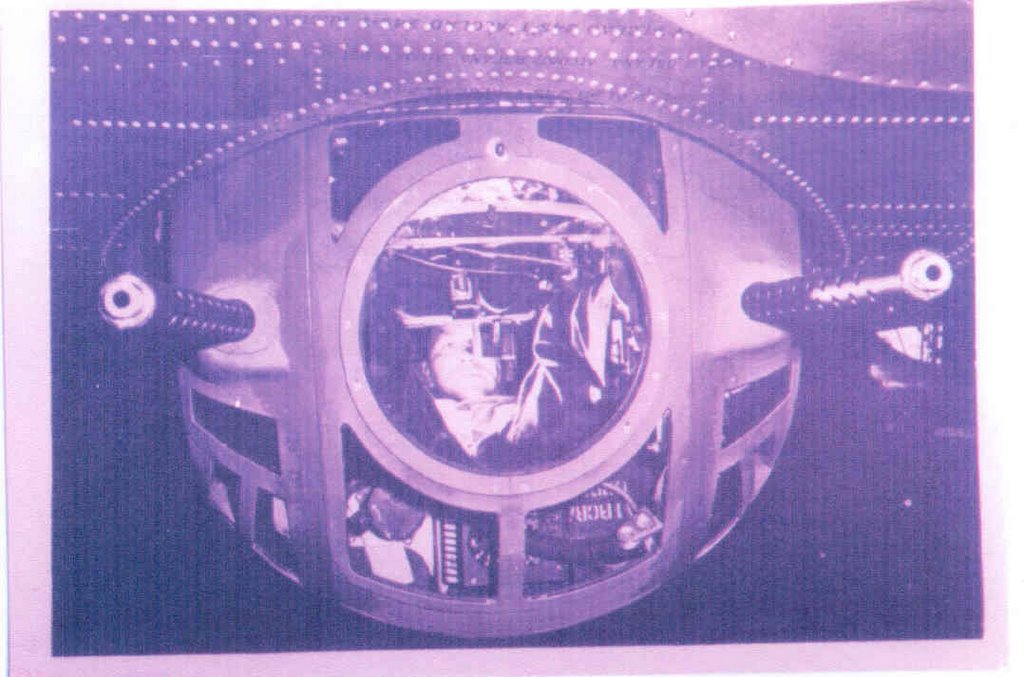
By depicting his gunner as a helpless pawn of the State Jarrell is guilty of a huge historical and philosophical error; but nonetheless his poem forced me, over time, to come to terms with exactly what a ball turret is and with the brute fact that human beings who were sometimes not even out their teens had the sheer balls to crawl into one of those things and stay there, in combat, for as long as nine hours at a time, in sometimes below freezing temperatures, cramped into a fetal position and skillfully operating equipment, and all the time risking death and very often meeting their deaths. Nothing I have ever done in my life up to this point has been anywhere near as dignified and honorable as cramming into a ball turret of a bomber plane and flying into combat in defense of human rights and political freedom. At this point in time I would no sooner be able to do that than to loose a flock of geese from my rear-end. Perhaps when I was younger, and if circumstances were drastically different... I don't know. I'll flatter myself with that thought for a while, even though I know it won't last.

And what of that whopping final line? To me it has always pointed to the ultimate tragedy of war, and to what seems at first glance as a complete waste of a human life. But isn't it shamefully ungrateful, at least for some of us, to regard Jarrell's dead gunner as a faceless pawn of a military machine who served no greater purpose than to be washed out of a ball turret with a hose? I think it is. Doesn't that final line trivialize the debt a great many of us owe to people like him, and to the fact that millions of people honor his memory to this day? I think maybe it does.

I can't say that I wish the poem had never been written, though I do wish it had been written differently. The poem is certainly outstanding, but maybe it's outstanding for the wrong reasons?

Ball turret gunner


" 'It's hard to imagine a worse place to go to war in then the ball turret position of the B-17 Flying Fortress,' begins one history. 'Isolated from the rest of the ten-man crew, the ball turret was extremely cramped quarters and required a man with a slight build. In almost every case, there was not enough room for the ball turret gunner to wear a parachute.'

Colonel Budd J. Peaslee, a noted Group commander, remarked, 'It is a hellish, stinking position in battle. The gunner must hunch his body, draw up his knees, and work into a half ball to meet the curving lines of the turret. The guns are to each side of his head, and they stab from the turret eyeball like two long splinters.'

The Sperry ball turret was designed not for comfort, but for the defense of the underside of an aircraft. It hung from the bottom of the belly of the B-17, a tiny, self-contained, womb-like aluminum ball, bristling with two 50-caliber machine guns. On most missions, the ball turret gunner remained cramped in the fetal position for as many as nine hours. Functions as simple as eating, drinking or going to the bathroom became impossible. Temperatures plunged to more than fifty degrees below zero.

If the plane were hit, the gunner was completely dependent on someone up in the main fuselage to open the ball and help him out. If those above were too busy or incapacitated, he rode the ball to his death." from "Untold Valor" by Rob Morris

11.11.2005

Aiming for plain speech

I've been sort of fixated lately on a period when I was mainly imitating the voices of other poets rather than trying to find my own. What I was doing at this time, which was roughly 1999-2001, was trying to incorporate my worldview into my poems in a way that I never had before. In this period I was heavily influenced by Ayn Rand's philosophy of Objectivism; and I obviously felt that the content of my poems was of far greater importance than the form or style, since the poetry itself, if it can be called that, which came from this period in my life was obviously nothing more than blatant imitations of Shakespeare and Milton, though I'm not sure I recognized that at the time of composition.

With the poem "Wallace", however, I was definitely trying to imitate Stevens, who I believe perfected IP to the point that he represented the logical progression of Shakespeare and Milton (and, to slightly lesser degrees, Tennyson and Keats) into the modern age. My ultimate goal I think was to arrive at some kind of stately formal style which was an amalgam of Shakespeare, Milton, and a dash of Stevens, with which I intended to pontificate and moralize in high-style. A modern day didactic poet with a mission.

What I wound up with, or course, was some unbelievably bad poems. Luckily for me, I didn't have a computer at this time. I did send a few of the poems out to magazines but none were taken, and no wonder. In July of 2001 I discovered PFFA and the following was the second poem I posted there. The first was a little piece which was ignored in General C&C; this poem was posted to High Critique, in the days of yore when the forum which is now called Advanced C&C was split into two fora: High and Merciless:


ODYSSEUS (FROM THE HORSE'S MOUTH)

Hell take the ships that were exalted shapes
On the canvas of your mind's eye, heroic vessels
That crested mountainous waves, that flew
With sails full blown in wind and rain:
All finery of a poet's vision, a blind
Fireside singer who, by immaculate singing,
Held my name from oblivion and turned
My deeds to legend. Now to the ash pit alarums
And clash of shields, the brazen shouts of war,
To Acheron the blood, the bristling of swords,
The heap of bodies in the languor of death,
For here is the matter in plain speech: I sailed
And battled with man and beast, redoubtable
In valor, braved the ire of jealous gods
On land and sea, knocked pell-mell like a doll;
But this is merely prop and scenery,
Superfluous adornment, artifice.
Pray, when you speak of me say this: he was
A soldier and seafaring gentleman.
Forget the empyrean lineage, forget
All talk of body's prowess, strength of sinew,
All incidental by-the-ways that gild
A common story. When you speak of me,
Recall I had a wife, a son. Say this:
He was a simple and self-centered man
Who strove for nothing but his hearth and home.


?/99


The poem was critiqued by Dunc and Bela, and the comments were accurate. Dunc suggested I find a voice rather than borrowing someone else's, and Bela smartly advised: "Dump the superfluous adornment, aim for the plain speech." I took the advice and have been working on writing poems ever since.

Because I have something of a masochistic streak running in me lately, I want to show you three other pieces written from this time period. After getting the advice from Bela and Dunc, and after taking the time to examine what I was doing and seeing how artificial and contrived some of my poems were, I quickly took these three pieces out of my main body of work and put them somewhere dark and secure. I forgot about them for a while but when I was going through my things recently I found them, along with "Lorca" and "Wallace", and I thought it would be neat to put them up here.

I am trying to be humble, despite that by my own definition of that word any attempt at humility has its source in that which is the opposite of humility; but whatever. I no longer think of myself as an Objectivist, although in terms of metaphysics and epistmology there is very little I find disagreeable in that system of thought. I am still an atheist but one who talks with God almost every day: which means I address the only concept of God which I find is deserving of worship: which means my concept of God in all Her supreme beauty, benevolence, and love (I don't use the feminine pronoun as a concession to political correctness at all. It's just that when I was composing a fictional story which delineated my personal concept of God ["
Embers of Servetus"], I discovered that my concept of God was overwhelmingly female. I also discovered that the narrator of my story was female during the process of writing it, which wasn't what I initially intended, what with the title and all).

What I didn't know back when I was writing these poems was that there were quite a few Objectivist poets around (refering not to the old "objectivist" school of poets but to Randian Objectivists). I believe that Mike Farmer is one and I spoke of the issue of being an Objectivist poet with him via email. Unfortunately, most of the stuff I've seen from them is pretty lousy. Not nearly as lousy as the three following pieces, but pretty dang lousy.

***


TO ONE WITH ADAM'S CURSE
(They understood that wisdom comes of beggary. - Yeats)

To speak so well of beggars, to applaud
the practice of beggary, albeit Christian,
dilutes the freshets of Pieria, refutes
at once all Apollonian testimony.
That wisdom comes of beggary? Better say
that knowledge is born of ignorance, that light
is born of darkness; let us claim, moreover,
that poetry, rather than an act of making,
is the inactive issue of idleness,
the insipid progeny of indolence.
We would placate the haters of poetry
thereby: irreverent men, the word be-mockers,
and do injustice to what monuments
our kindred made on hallowed Helicon.
That mendicants exist is true; yet though
they are accorded a type of blessedness,
an impotence that ravishes the heart
and frailty akin to piety,
we need not take them as a sign or blessing,
for little or nothing comes of beggary.

4/99


TESTAMENT FOR A DEATH-BED

I would with devils in Abaddon dwell
than hymn forever on green hills in Heaven,
inhabit darkness and, in adamant chains
transfixed, in contemplation think for aeons;
albeit time become irrelevant,
eyes obsolete, and flesh inured to torment,
accosted in bleak perpetuity
by hideous and unconscionable furies,---
and yet a grave were better, or such fire
as turns the sinew to inanimate dust
and makes a paltry powder of the bone.
Better the mercy of oblivion
than be mere parcel of a throng that trills
in sycophantic everlasting. Come,
sweet consummating flames, finish by fire
days lived in joy, untrammeled by hosannas.

4/99


THAT OLD SAW
(And there shall be beautiful things made new... - Keats)

Beautiful things made new? Furnish a sty
with cleanlier muck where swill recidivous swine,
wallowing, slothful, unrepentent beasts?
Better to ford them over Acheron
A succulent fodder for the tines of furies
or supple fat for talons fain to rend.
Our house is built upon a clasping loam
that draws us ever deeper into mire.
Knock the house down, or suffocate in flame
the flagging timber, dress the walls with fire
that they may dance into oblivion
as bright as high-born women at a dance,
resplendent in annihilation. Build
(again, with trowel and sword in either hand:
that old saw. Though you've heard it often enough
it bears repeating) over solid ground.


4/99


I warned ya.....

10.25.2005

Second scene from "Flatus"

The following fragment of the play, which is generally thought to have been a work in progress by William Shakespeare, The Passing of Flatus, appeared only yesterday in the Camelot Omelet. In this scene, Slappy is trying to make Flatus interested in love and romance, but why he is doing this cannot be determined by the material that has surfaced so far. The dialogue is interesting in that obviously they are both talking mostly to themselves. What a Clever-Dick that Shakespeare was!

As for the objections over the name "Slappy", Matthew Ferherdermer, of Cambridge University, has published an interesting article in the Hamlet Amulet which brings to light the fact that Slappy was actually a popular name in Rome around the time of Christ, a familiar form of Slaphicus, as well as in Medieval England, where it was an extremely common nickname for Euoweyr or Bertrand. It was also commonplace for people in both time periods to refer to their subordinates as "Slappy", because of the instant and stinging humiliation that appellation caused.

***

Act two. Scene three. A field.


SLAPPY:
In sober celebration of the flesh,
In frequent venting of conscupiscence,
Make sportive tricks, lascivious caperings;
To truncate suffering, to kill desire,
To turn the cold valves of hard chastity,
To flush the chilled-fast vein with amorous fever,
Fill eyes with ardor, lips with wantonness;
To linger kissing at the coronet
That crowns with pink the sweet unsettled fat
Soft-covered in white silk: to lift, to weigh
The supple globes, to bring an agitation,
To set them dancing, pendulously bellied;
To brace the rider as she sits a' saddle
Rocking moist in fever, eyes full-lustered
As if made bright with wine: but ne'er have spirits
Kindled those orbs to blaze with such wild fire,
Nay, but thy johnson, Flatus, doth the trick,
That tickler of a lady's nether parts,
That prickling rogue, that bold up-popping jack,
That meddling serpent: he it is that maketh
Etnas of those soft-tufted mounds of Venus.


FLATUS:
Of all the fancies which a god constructs
And plants within the gardens of men's brains
Can any be less sensible than love?
Pernicious little elf! No viler cherub
Did from Olympus like foul weather come!


SLAPPY:
Equestrienne, she vaunts her cloven haunches
And ruts upon the rigid post: she slides
And tugs and urges with her slippery cleft.
Her lips she bites, and through hard-clenched teeth
Makes a licentious and unsyllabled moan.
A moment's pause: her opulent rump she rests,
Now richly radiant with damp scented musk.
Anon she chomps the bit, is fain to ride.
Cry "tally-ho!" and beat the bushes, liege; but whither
Goest Raynard? He hast hied him to that furrow,
That steeped cravase, that gorge of living blood,
And butts his nose in darkness, like a mole,
And tunnels further in the teeming trench.


FLATUS:
Of all the mad dreams which a man invents
And sows among the pastures of his heart
There can be none of greater detriment
Than that obnoxious malady called 'Love'.
'Tis a disease which thrives upon his blood
And rages in his veins like potent drink.
It makes a man a fool with tongue unloosed
Who in the street cries nightly like an owl,
"Tu-whit! To-whoo!", who in full wretchedness
Leans under ladies' windows, eyes uprolled,
His hands upon a full wide-bottomed lute,
Who with rude breath, wrought of the stench of love,
Sings some cracked tune to win him but a kiss!


SLAPPY:
Our rider, perched high in her wonted seat,
She gallops on apace, now all unkempt
And covered with a sheen of salty sweats;
Her breasts, like fruits grown soft and over-ripe,
Tumescent, turgid with excess of juice,
Depend and sway. Now in thy fetching fingers
Gather good harvest, hold, palpate, and press;
Stretch toes to the horizon. Hot purgation
Cleanseth the vein: froth of the seeded spate,
Spat foam of expiation, pulsed expulsion
Of lecherous lust. From such brief violence
Is wrung a season of tranquility,
Of tender-taken breath, of mellowed blood,
That tempers now the chambers of the heart.
Now johnson nods his head; he curleth up
And slips into the coverlet of sleep.


FLATUS:
I say love doth engender silliness
And drives a man to ponder strange designs;
Makes him to lie supine upon a hill
And then discern wild creatures in the clouds.
Love makes a man a coward: he will leave
His sword upon his hip and bends him low
To pluck a rose, and there he stands and grins,
Comparing leaves to lips, and dreams a sonnet!


SLAPPY:
Nay, but thou wilt not hear me, liege. Wilt hear?
Nay, but thou wilt not. Liege, if it so please thee,
I'll take my leave. There is some trouble yonder,
Some noise or other.


FLATUS:
I hear nothing. Wither?


SLAPPY:
(points distractedly) Thither. (runs off, rubbing hands together)